For Leaders & Executives

Before the meeting, know your recommendation holds up.

Thanis reviews your recommendation, identifies weak reasoning and critical assumptions, and shows you what needs attention before you share it.

No AI rewriting·No training on your work·You make the final edits

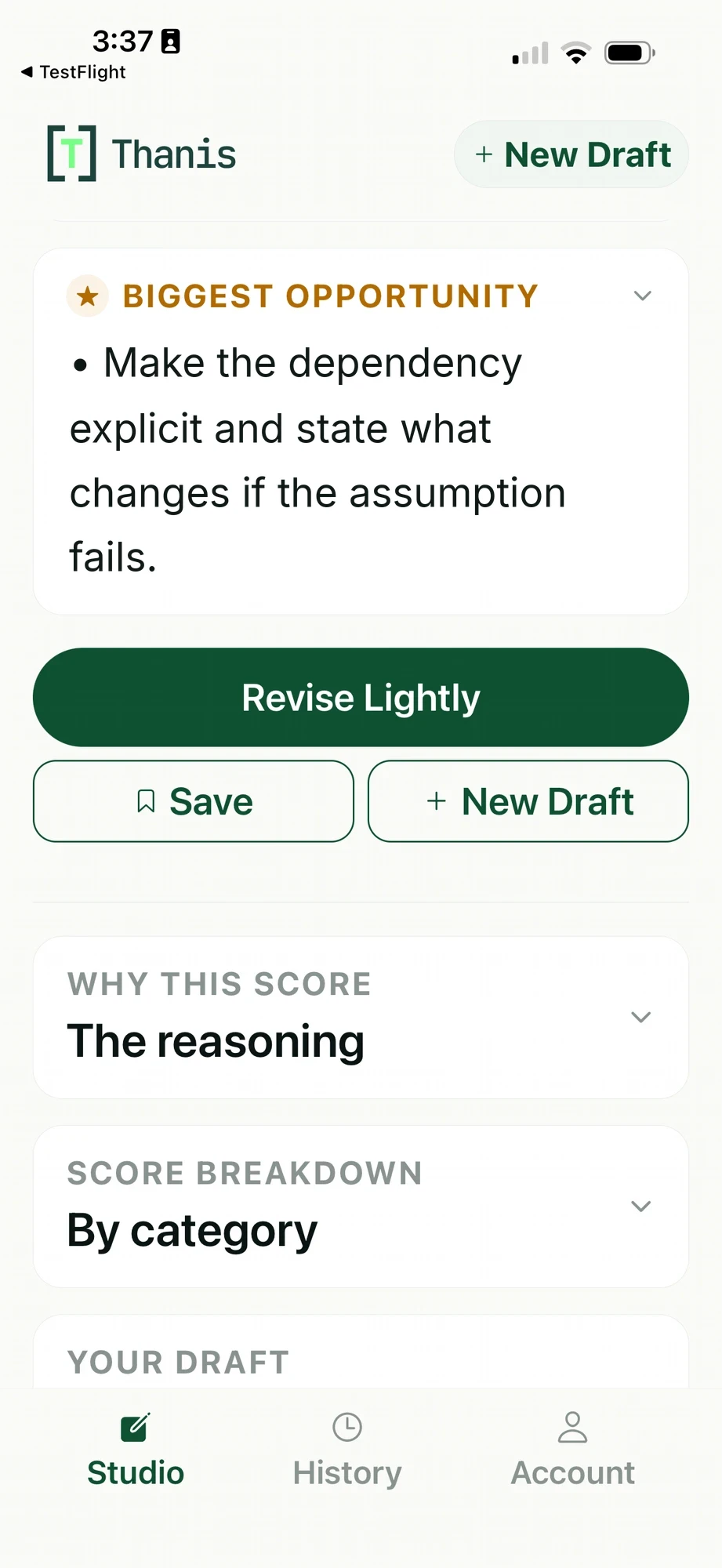
Thanis on iPhone — Biggest Opportunity for a leadership memo: make the dependency explicit and state what changes if the assumption fails.
Before it reaches the room

Before the message goes out, ask four questions.

A polished memo can still hide a weak recommendation. Thanis identifies the questions a board member, investor, or decision-maker is likely to ask next.

Is the recommendation clear?

Can the reader tell what should happen, why, and what decision is being asked for?

Does the reasoning hold up?

See where the argument skips a step, relies on thin support, or overstates certainty.

What assumption could change the outcome?

Identify the assumption most critical to the recommendation’s success.

Is ownership clear?

Make sure the message names who decides, who acts, and who is accountable.

The assumption underneath

Find the assumption the recommendation depends on.

A polished memo can still rest on one weak or unstated belief. Thanis identifies it before the message reaches the people who have to act on it.

A real example
The recommendation

“We recommend consolidating the two regional support teams under one operating lead beginning in Q1.”

Critical assumption

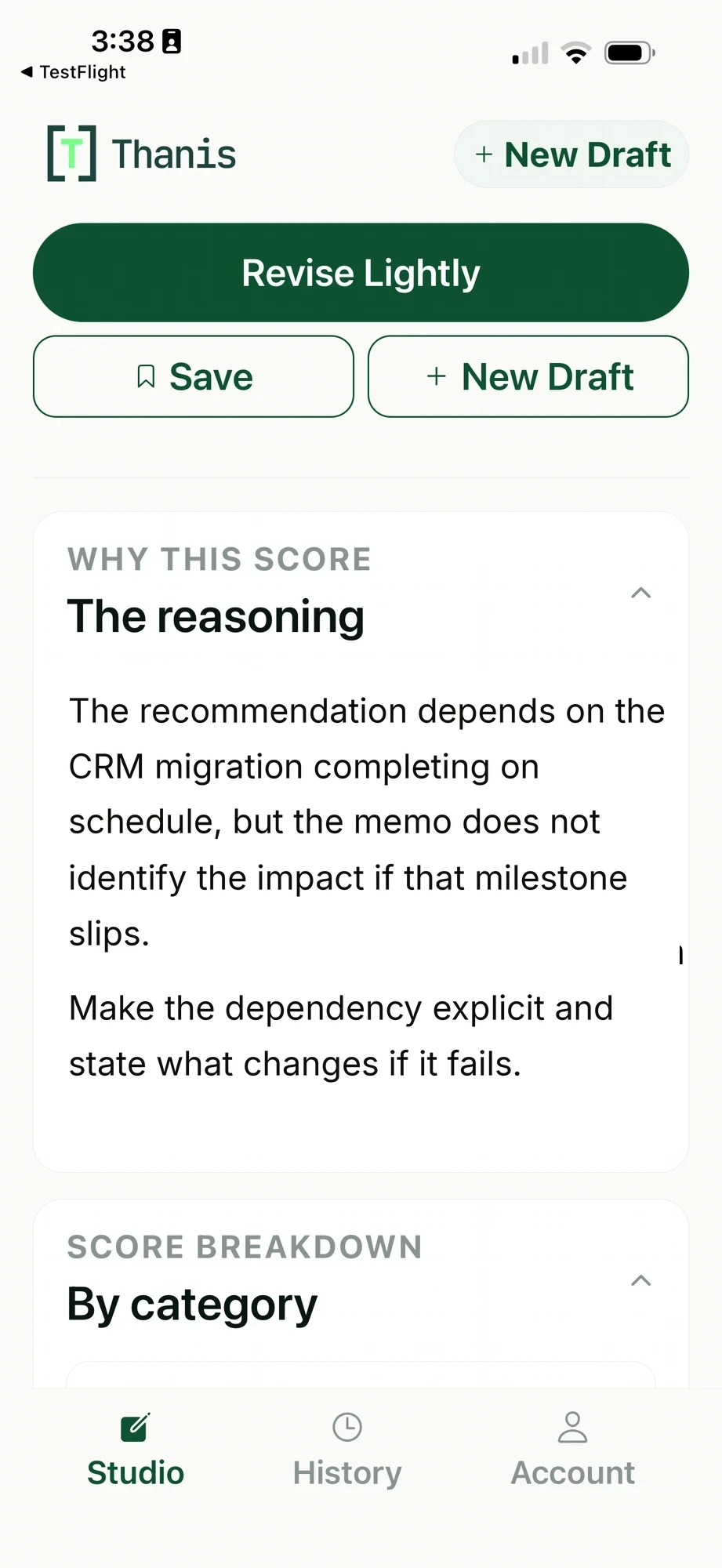
The recommendation depends on the CRM migration completing on schedule. The memo does not explain what changes if that milestone slips.

Priority revision

Make the dependency explicit and state what changes if the assumption fails.

  1. What the recommendation assumes

    Thanis names the belief the case rests on.

  2. What changes if the assumption is wrong

    See how the outcome shifts if the premise fails.

  3. What the memo should make explicit

    The condition to state — and who owns it.

Applied toBoard updateStrategy memoTransformation proposalInvestment recommendationPolicy briefingStakeholder communication

Thanis names the assumption. You decide whether to keep it, qualify it, or defend it.

The review

Know where your recommendation stands.

See what’s working, what needs attention, and what to revise before you share it.

  • Draft Readiness

    Is your recommendation ready for its intended audience?

  • Priority Revision

    Identify the change most likely to strengthen your recommendation.

  • Category Scores

    Review scores for Clarity, Structure, Mechanics, and Risk.

  • Clear Explanations

    Understand each score and what to revise next.

Thanis on iPhone — the reasoning behind the review: the recommendation depends on the CRM migration completing on schedule, but the memo does not identify the impact if that milestone slips.
See it in full

Preview a sample review before you sign up.

This is the kind of one-page review Thanis returns on a real board memo — readiness, category scores, the assumption the case depends on, and what to revise first.

Sample Executive Review
Board update

The recommendation under review

“We recommend consolidating the two regional support teams under one operating lead beginning in Q1.”

Draft readiness
Revise Lightly

The recommendation is close. One dependency needs to be made explicit before it goes out.

Category scores
Clarity82
Structure78
Mechanics88
Risk64
Critical assumption

The recommendation depends on the CRM migration completing on schedule. The memo does not explain what changes if that milestone slips.

Priority revision

Make the dependency explicit and state what changes if the assumption fails.

Why this result

The case is well organized and clearly written. The risk is not the wording — it is the unstated dependency. Name it, and the recommendation holds up under questions.

Illustrative example based on a real Executive review. Category scores are representative; the readiness result, critical assumption, and priority revision reflect an actual review of this memo.

This is a preview. Thanis reviews your own memo the same way. You decide what to change.

Built for leadership communication

Built for high-stakes leadership communication.

Board recommendations

Strategy & transformation proposals

Investor & leadership updates

Policy, risk & incident communications

Executive speaking during a business presentation.
Important decisions often begin in writing.
Why Thanis is different

AI can generate the message.
Leaders still own the decision.

Generation can make a message sound polished. Thanis helps you evaluate whether the recommendation inside it is clear, supported, and accountable.

The writer
Generative AI
  • Drafts and rewrites quickly
  • Helps organize ideas
  • Can make an argument sound polished
  • Does not own the recommendation
The reviewer
Thanis
  • Reads what you wrote
  • Tests the reasoning
  • Identifies assumptions, risk, and unclear ownership
  • Leaves the final decision with you
Plans

Start free. Upgrade when you're ready.

Deeper feedback, more history, and higher limits when you want them.

Basic

$0.00 /mo
For everyone
  • 1,500 word limit per analysis
  • Basic history (last 5 scans)
  • Creative Mode only

Academic

$9.99 /mo
Best for academic writing
  • 30 analyses per month
  • 5,000-word draft limit
  • Rubric support for papers and assignments

Writer Pro

$14.99 /mo
For heavy writing workflows
  • 75 analyses per month
  • Deep Trace™ pattern detection across drafts
  • Unlimited saves and history
Recommended

Executive

$24.99 /mo
For leadership communication
  • Executive memos, board updates, strategic comms
  • Critical Assumption analysis
  • Voice preservation for high-stakes writing

Before you send the recommendation,
see what still needs work.

Run the draft through Thanis to see where the reasoning weakens, which assumption matters most, and what to revise first.